Europe has world-class quantum research, a growing industrial ecosystem and significant strengths across quantum hardware and enabling technologies. The next challenge is ensuring that these capabilities can translate into competitive industrial capacity in Europe.
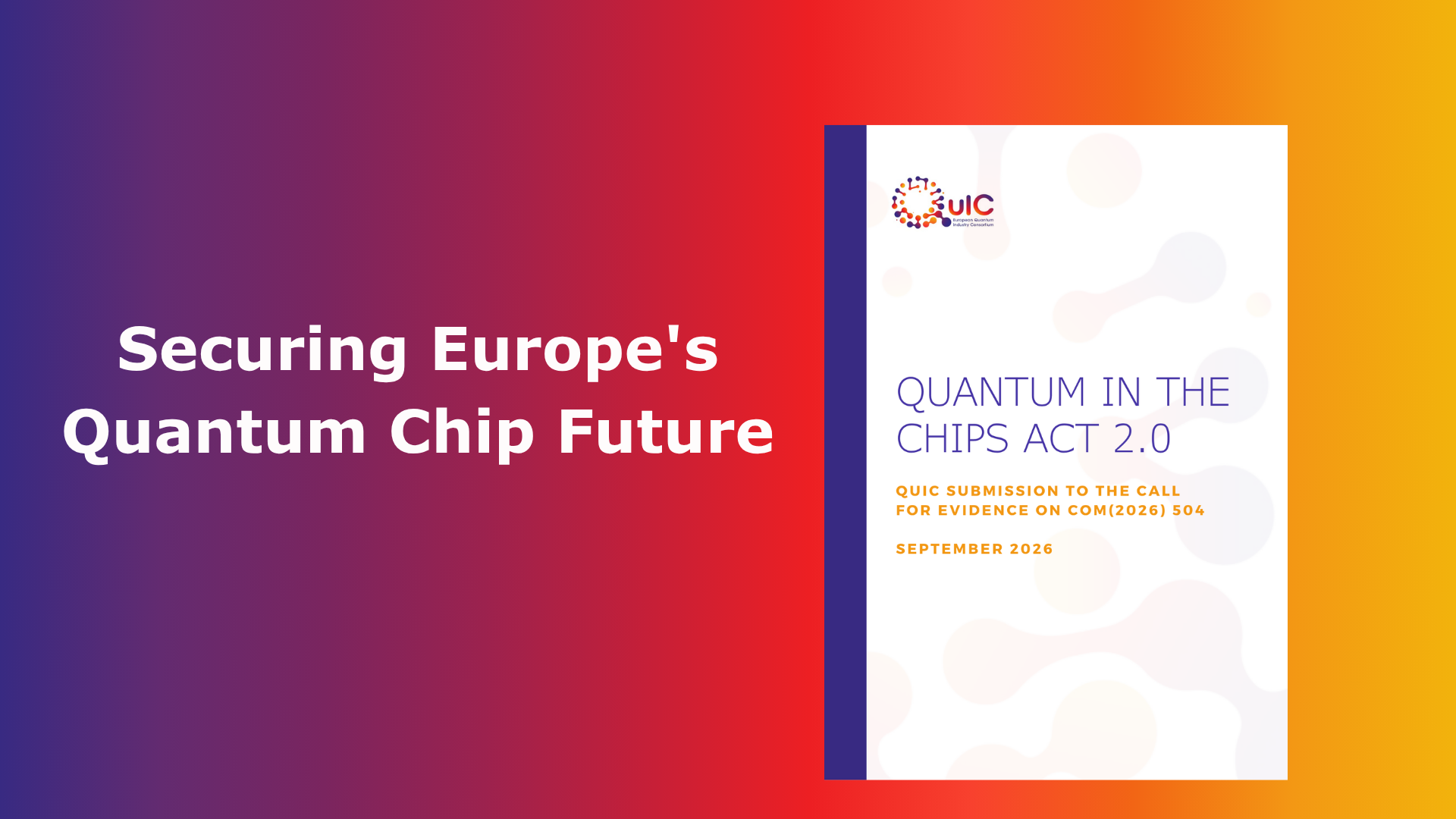
In our new whitepaper, Quantum in the Chips Act 2.0, the European Quantum Industry Consortium (QuIC) presents the perspective of Europe’s quantum industry on the European Commission’s Chips Act 2.0 proposal.
QuIC welcomes the continued recognition of quantum technologies within the proposal, including the definition of quantum chips, the six quantum pilot lines and support for enabling technologies. However, important questions remain around how Europe moves from research and prototyping towards production-grade quantum chip industrialisation.
What you will learn
The whitepaper explores:
- What quantum chip industrialisation requires, including production-grade fabrication, multi-project wafer access, cryogenic testing, packaging, metrology and design enablement.
- What the Chips Act 2.0 currently delivers for quantum, and where QuIC identifies gaps between research infrastructure and industrial-scale production.
- Why Europe’s fabrication capacity and supply-chain resilience matter, particularly as quantum fabrication assets and capabilities are increasingly consolidated internationally.
- What European quantum companies need today, rather than simply what might be required when the sector reaches larger production volumes.
- How quantum should be incorporated into the Chips Act’s strategic priorities and monitoring framework, including QuIC’s proposed indicators for measuring European quantum industrialisation.
- How the Chips Act 2.0 and forthcoming Quantum Act should complement one another, creating a coherent European framework from chip fabrication through to systems, applications and adoption.
- QuIC’s recommendations for policymakers, including measures covering fabrication infrastructure, small-scale production, IP and licensing, quantum photonics, enabling hardware and industry involvement in governance.
The paper does not argue that Europe needs to build a large-scale quantum foundry immediately. Instead, it asks an important question: is Europe putting the infrastructure, policy framework and industrial pathways in place today so that it can scale when quantum technologies are ready?
Read the whitepaper
Europe has the scientific capability. The challenge now is converting that strength into sustainable industrial capacity.
Read Quantum in the Chips Act 2.0 to explore QuIC’s analysis and recommendations for strengthening the position of quantum within Europe’s future semiconductor ecosystem.
QuIC would like to thank our contributors for their valuable expertise and contributions to this whitepaper:
Dr Emanuele Pelucchi
Prof Giorgos Fagas
Dr Louise Burgoyne of Tyndall National Institute
Dr Michael Bauer of Bull
Martin Farnan of Equal1 Labs
Dr Cécile M. Perrault of QuIC
Dr Thomas Luschmann of Peak Quantum GmbH
Dr Eva Martín Fierro of Qilimanjaro Quantum Tech
Their input helps ensure that the needs and perspectives of Europe’s quantum industry are represented as the Chips Act 2.0 progresses through the legislative process.